Client Diversity, Generated
Client diversity — running several independently-written implementations of the same protocol so no single bug can finalize an invalid chain — has always been the right fix for consensus risk: even a mathematically perfect protocol still has to be implemented in code, and no proof of the algorithm touches the bugs that creep in during that translation. It's also always been the expensive one: a production-grade client is years of engineering and tens of millions of dollars, which is why most chains have one dominant client and a thin second one, not five.
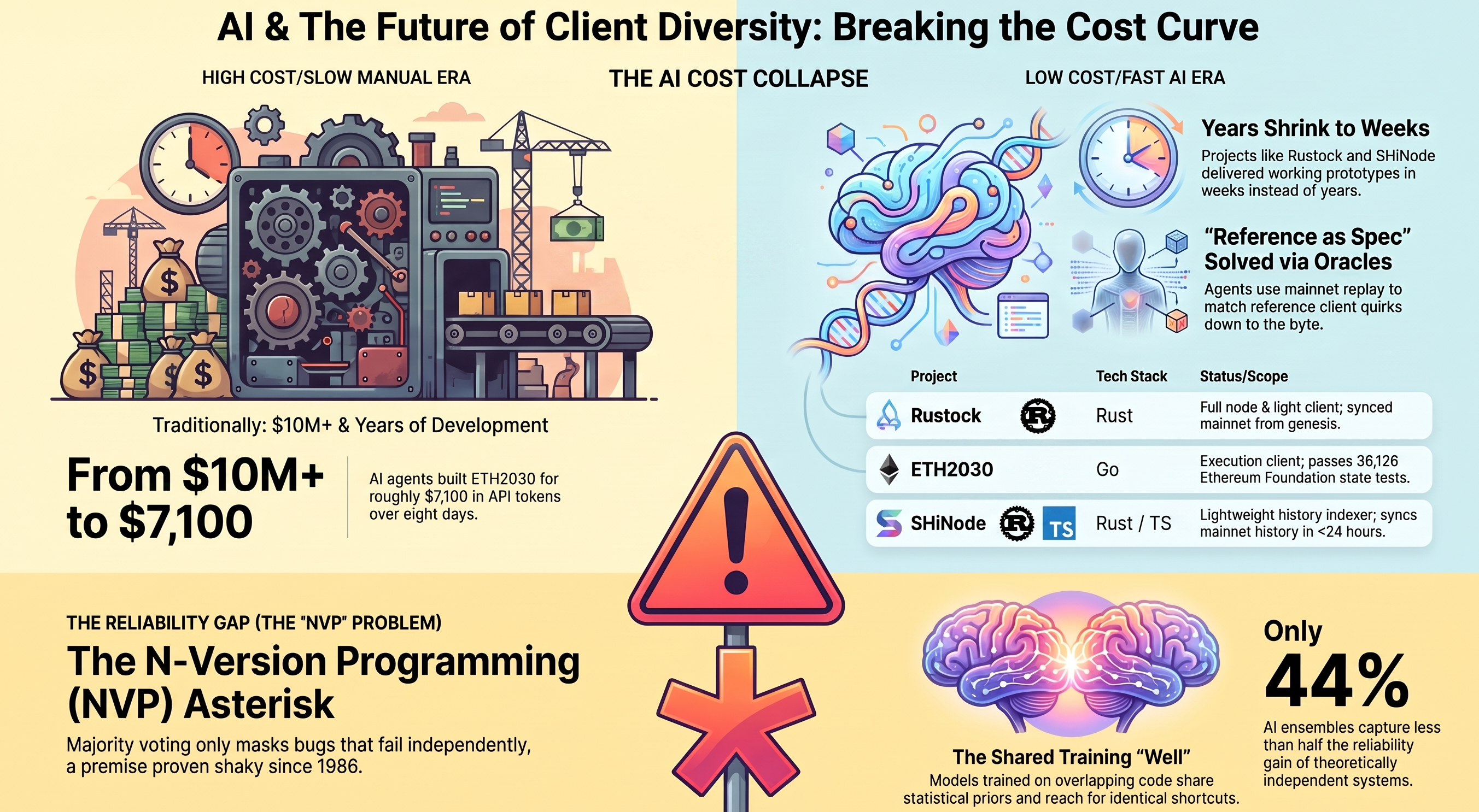
AI coding agents are genuinely changing that cost curve — engineers could be shipping working execution clients, in Rust, Go, and Zig, in weeks instead of years. What they aren't automatically changing is the fifty-year-old catch built into N-Version Programming (NVP), the fault-tolerance theory that makes N implementations worth more than one: majority voting only masks bugs that fail independently, and the evidence on whether AI-generated clients clear that bar is a lot shakier than the headline case studies suggest.
The cost-collapse holds up: Rustock, ETH2030, XVI/Guillotine, and SHiNode are genuine, working clients. What doesn't hold up is treating cheaper client-writing as equivalent to more client diversity in the sense that actually matters — NVP's fault-masking guarantee has needed an asterisk since Knight and Leveson's 1986 study, and the current evidence on AI-generated ensembles says the same thing: real fault reduction is achievable, full independence isn't.
Yet many questions remain: can a shared, machine-checked specification generate a consistent family of full nodes, light clients, and indexers instead of today's unrelated one-off agent projects, how to actually measure failure independence at scale, and whether anyone will pay a validator to run the minority client once it exists.
The claim behind this post is simple and, on the evidence, mostly right: autonomous AI coding agents — Claude Code, Cursor, Gemini — can now mostly synthesize working blockchain clients from scratch, without a team of engineers spending years on it.
Before we get into any of that: it's worth being explicit about why this is worth writing about at all.
Testing blockchain infrastructure is unusually hard, for a reason ordinary software mostly doesn't share — the client's correctness is the integrity guarantee. In a centralized system, a database bug is a bug: annoying, costly, fixable with a patch and an apology. In a decentralized one, there's no operator to trust and no maintenance window to fix things quietly — the client's behavior has to be right across a state space no test suite can fully enumerate, forever, with real money on the line the moment it isn't.
This blog's own two-part look at verified consensus covers the most rigorous attempt to close that gap — machine-checked proofs of the consensus algorithm itself — and Part 2's verdict is that even those proofs stop at the algorithm, never quite reaching the production binary actually running.
That's the entire reason to want more than one implementation in the first place. Decentralization isn't an aesthetic preference — it's what lets a network survive a captured, coerced, or simply broken operator without asking anyone's permission to keep running.
It's also not one dimension: Buterin's own framing of the meaning of decentralization splits it into political (how many people or organizations control the nodes), architectural (how many machines can fail at once without taking the system down), and logical (whether the system presents as one unified state or an amorphous swarm) — largely independent axes, so a chain can score well on one while quietly failing another.
Client diversity is squarely an architectural decentralization mechanism: a blockchain can be politically decentralized, with thousands of unrelated operators, and still have almost no architectural decentralization if all of them are running the same binary. A blockchain with one client, one company, or one point of control has quietly become the centralized system it was built to replace; censorship resistance and the promise that no single party can freeze funds or rewrite history both depend on nobody's individual mistake being able to take the whole network down.
History backs up how easily that promise — that no single client's mistake can take down the whole network — fails when there's nothing but luck standing behind it. Both incidents below happened while Bitcoin ran on what was effectively one client, with no second implementation around to disagree.
On August 15, 2010, an integer overflow in Bitcoin's own client (CVE-2010-5139) let a single transaction mint roughly 184 billion BTC out of nothing; the network caught it and forked to a corrected chain within about five hours, only because Satoshi and a handful of early developers happened to be watching closely enough.
Less than three years later, in March 2013, Bitcoin split into two competing chains for roughly five hours when v0.8 clients — freshly migrated to LevelDB — accepted a large block that v0.7 clients, still bound by Berkeley DB's 10,000-lock limit, rejected outright.
Not an attack, just two versions of the same reference client quietly disagreeing about what a valid block was, resolved only because miners coordinated by hand to roll back to the older version. Both bugs lived in the most-trusted software on the network, undetected, until real money made the cost of finding out unavoidable.
01 Client Diversity
Client diversity is one of those fixes that is obviously right and yet routinely skipped — this section covers the mechanism that makes it work: catching a bug because two independent implementations disagree about what actually happened.
In a distributed state machine, every node has to independently compute the same state root after replaying the same transactions. Client diversity — running multiple independently-written implementations of the same protocol side by side — exists because a bug in the dominant implementation is a bug in the network whenever enough validators run it.
This directly cuts into the difference between the algorithm and its implementation discussed in the consensus posts.
Ethereum's own community guidance is explicit about the threshold: no single execution or consensus client should cross roughly a third of the network's validation power, because that's the point past which a client-specific bug can finalize an invalid chain outright rather than just embarrassing the minority running it.
That's not a hypothetical concern.
- In January 2024, a bug in the Nethermind execution client caused roughly 8% of Ethereum's validators to start producing invalid blocks. Because Nethermind was one of several independent clients rather than the only one, the network kept finalizing correctly on the majority behavior — the fault stayed contained to the minority running that specific software, visible almost immediately as a client disagreeing with everyone else, and patched within hours.
- Solana ran on a single dominant client, Agave, for years; Firedancer, an independent from-scratch reimplementation by Jump Crypto, only reached mainnet in 2026 — giving Solana real client diversity for the first time, years after the network needed it.
The mechanism is old and unglamorous: disagreement between independent implementations is itself a bug detector, catching exactly the class of fault — one implementation's subtle deviation from spec — that no amount of internal testing catches by definition, because a single codebase can't disagree with itself.
The question at the heart of this post is whether AI-generated clients give the network more of that property, or just more code that looks like it.
02 Why Nobody Builds a Second Client
If disagreement between clients is such a useful bug detector, the obvious and natural question is why most chains don't have five independent implementations already. Three structural reasons, and none of them are exotic:
Three Structural Reasons
- Implementation and maintenance costs. A production-grade full node means an EVM or state-transition execution engine, cryptographic precompiles, state trie persistence (Merkle-Patricia or Verkle trees), a peer-to-peer networking stack, and a JSON-RPC surface — then keeping all of that in parity across every new client, indefinitely, as a second full-time job layered on top of the first. AI compresses the first half of that cost, the initial build, far more than the second — staying in parity with every future upgrade is a standing commitment, not a one-time generation.
- The "reference as spec" problem. Plenty of blockchains have never had a formal specification document; the reference implementation is the spec. Rootstock is the clean example:
rskj, written in Java, defines correct behavior by what it actually does, not by what a document says it should do. Replicating that means matching Java-specific quirks —BigIntegerbyte encodings, hash-set iteration order, integer overflow behavior — down to the exact byte, in a different language. A second client built against the intended logic rather than the reference implementation's specific quirks is a second client that risks forking the network the first time it hits one of those quirks in production. - Client monopoly traps. Node operators, staking pools, and dApp developers converge on whichever client is most tested because they're optimizing for stability — which starves every minority client of the exact adoption and bug reports it needs to become trustworthy, a feedback loop that reinforces the concentration client diversity is supposed to fix.
As mentioned, what AI coding agents plausibly change is the first of those three, and only partially.
An agent can write hundreds of thousands of lines of EVM execution logic in days rather than years — the second and third problems, matching reference-implementation quirks and overcoming an incumbent's trust advantage, are unaffected by how fast the first draft gets written.
| Chain | Production clients | Named clients | Dominant client's share |
|---|---|---|---|
| Ethereum (execution) | 5 | Geth, Nethermind, Besu, Reth, Erigon | Geth ~50% |
| Ethereum (consensus) | 6+ | Lighthouse, Prysm, Teku, Nimbus, Lodestar, Grandine | Lighthouse ~51% |
| Bitcoin | 2 | Bitcoin Core, Bitcoin Knots | Core ~75–85% |
| Solana | 3 | Agave, Jito-Solana, Firedancer | Jito-Solana ~72–88% of stake |
| Avalanche | 1 | AvalancheGo | ~100% |
| Rootstock (RSK) | 1 | rskj | ~100% |
The Cost of a Second Client
The table above puts a number on the gap between the boring fix and how often chains actually have it: how many independently-built clients the largest networks run in production today, and how lopsided the split still is even where diversity nominally exists.
Ethereum's row above is the exception, not the rule — and it took years of public shaming by exactly the dashboards cited in that caption to get there. The gap between that row and everyone else's is the market these case studies are selling into.
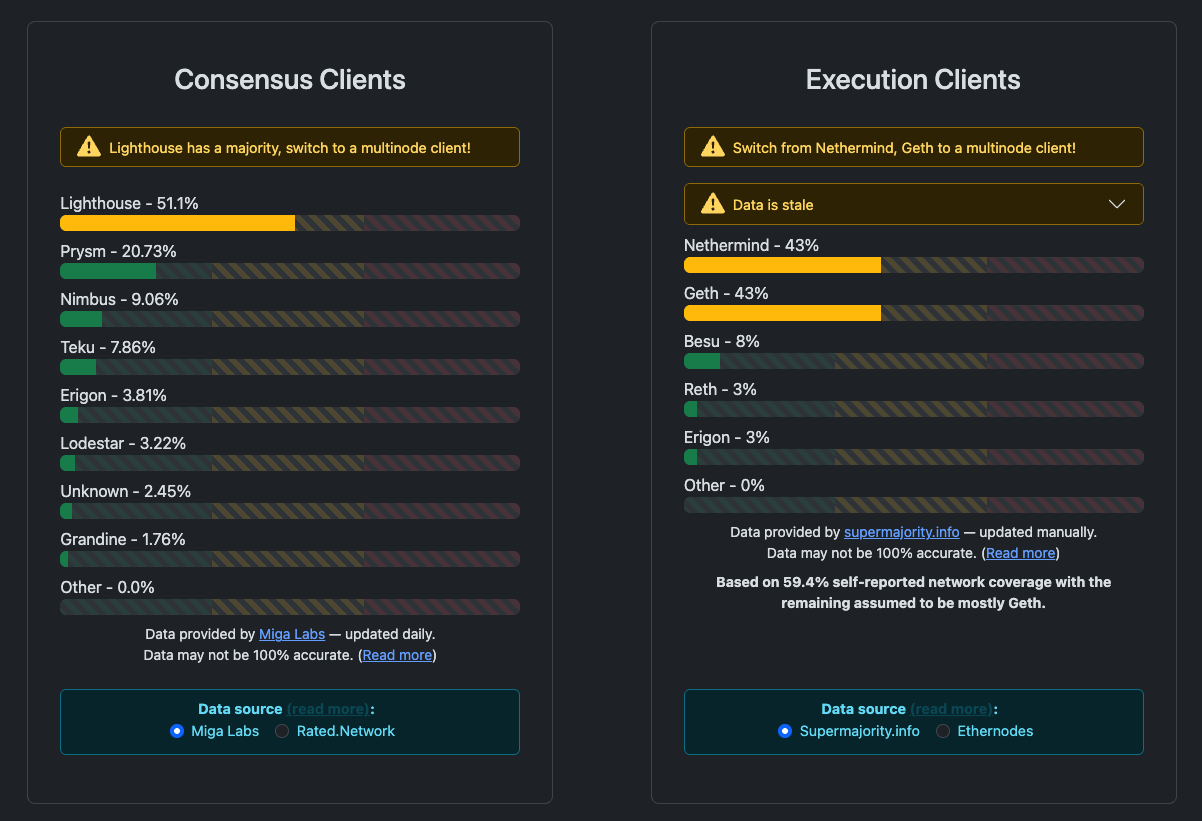
Numbers this volatile are exactly why a snapshot table isn't the whole story: the real question isn't what either dashboard says today, but whether AI-generated clients make building a second implementation cheap enough for these percentages to keep moving in the right direction.
03 Four Case Studies, Read Carefully
All four projects the source names trace back to something real: Rustock and ETH2030 are AI-generated full and execution clients that already sync against live chains, XVI and Guillotine are two parallel EVM execution engines at very different stages of AI involvement, and SHiNode is a lightweight history indexer running on the least verification of the four.
Rustock
// github.com/javicid/rustock · Medium post · full node — syncs mainnet from genesis, not production-ready
Javier Cid's Medium post is the primary source for this case study. The three-toolchain workflow is real: Gemini 3 on Google Antigravity for architectural decomposition, Cursor running Claude Opus 4.5 for the hard EVM precompiles (the BTC–RSK Bridge, REMASC), and Claude Code running long, unattended background sync loops under a CLAUDE.md policy file. That file isn't actually committed to the public repo, so its contents aren't independently checkable.
The oracle strategy is the genuinely interesting part: unit tests generated by the same models that wrote the code kept missing subtle protocol nuances, so the author used live-chain mainnet replay against rskj as ground truth instead of the generated unit tests — running the client, catching a divergence, querying the reference implementation's database, fixing, resuming, unattended.
The Rustock repository itself backs up the sync claim and adds detail the source doesn't mention: 242 commits over roughly five months, 786 tests across consensus validation, the full Unitrie world-state implementation, every RSK precompile including the complete Bridge surface, RLPx P2P networking, and an rskj-compatible JSON-RPC server — a genuinely substantial full node under sustained development, not a one-shot generation. It also opens with a warning banner:
Rustock is a prototype implemented in an AI-assisted manner. It should never be used in production. The code has not been reviewed in depth and has not been security audited. It may — and will — break and contain bugs.
The repository's own docs/ directory is the best evidence for the "reference as spec" problem described in the previous section. Its quirks catalogue documents byte-level rskj behaviors that were never a deliberate design choice — an unconditional write, a missed reset — but hardened into consensus anyway because historical mainnet blocks now depend on them.
- Zero-balance encoding. One entry: rskj encodes an account's zero balance as a bare
0x00byte rather than standard RLP's empty-value encoding, a quirk traced by exporting rskj's own state at block #3,397 and diffing it byte-for-byte against Rustock's output until the two matched across all 7,588 leaves. That's the "matching quirks down to the exact byte" problem from the previous section, not as a hypothetical, but as a commit log. - Known limitations. The README's own limitations list is specific: no mining or block production (Rustock validates and replays blocks; it doesn't propose them), no archive-vs-pruning policy, roughly a third of the Bridge precompile's local-only getter methods still unfilled, and no
debug_*ortrace_*RPC namespaces. None of that contradicts the sync-speed claim — it just means "successfully synced mainnet from genesis" and "ready to run as a second production client" are different milestones, and only the first one has happened.
rskj as ground truth instead. Sync, catch a divergence, query the reference database, patch, resume — unattended.ETH2030
// github.com/jiayaoqijia/eth2030 · eth2030.com · execution client — passes EF state tests, not production-grade
This one is the best-documented of the four, and it goes deeper than the scale claim once you follow it. The repository and project site back up the headline number — 65 roadmap items built by integrating against a go-ethereum v1.17.0 base rather than from a blank file, not a from-scratch rewrite — and it passes all 36,126 Ethereum Foundation state tests it targets, matching the source's figure exactly. The line count keeps moving: roughly 702,000 at the time the source cites it, and past 790,000 by the time this post was checked, since the repo hasn't stopped growing.
The repo's own Development Stats table discloses the build itself in the same three-toolchain-style detail Rustock's post does, and the source doesn't mention any of it: Claude Code running Opus 4 and 4.6 over roughly eight days, 3.42 billion tokens billed across 34,172 API calls, 966 session transcripts — nine main sessions, 957 sub-agent runs — for an estimated $7,100 total, about $10.19 per thousand lines of the result.
The commit graph complicates the implied solo-build framing, though. 877 commits between February 17 and April 22, 2026, split across four contributors — and the named author, jiayaoqijia, isn't the one who wrote most of it: fyInALT holds 592 commits, 67% of the total, against jiayaoqijia's 277. The eight-day build figure and the roughly ten-week commit span aren't necessarily in tension — token-billed session time and calendar time are different clocks, and nothing here rules out compressed, high-intensity sessions spread across two months — but the same discipline this section keeps applying to the source cuts both ways: don't repeat a solo-author framing the commit log doesn't actually support.
The repo's own gap analysis is ETH2030's version of Rustock's quirks catalogue, and just as specific:
- KZG commitments currently run against a placeholder backend — real polynomial evaluation, but a test SRS rather than a production trusted setup.
- Groth16 zk-circuit integration is listed as pending, not implemented.
- 26 custom opcodes (
CLZ,DUPN,SWAPN,EXCHANGE,AAamong them) are flagged as permanently ETH2030-native rather than portable, because go-ethereum's ownoperationandJumpTabletypes aren't exported for another implementation to extend.
That's a concrete engineering constraint, not a hedge — the same "matching the reference down to the byte" problem Rustock's quirks catalogue documents, just showing up as an unexported Go type instead of a byte-encoding quirk.
What doesn't survive the trip back to the source is the framing of Ethereum co-founder Vitalik Buterin's endorsement. He reacted publicly, calling it an "impressive experiment" — but in the same breath, hedged it explicitly: the project "almost certainly" contains critical bugs and stub implementations, and his interest was in what agentic coding can prototype quickly, not a claim that the output is production-grade. Citing that tweet as validation of AI-generated-client readiness, without the hedge attached to it, inflates what its own author said.
The roadmap ETH2030 targets is real, too, not an invented label: the L1 Strawman is the Ethereum Foundation Architecture team's own long-range simplification roadmap, publicly floated by Justin Drake out of a January 2026 EF workshop and tracked at strawmap.org — ETH2030 is one attempt to actually build against a roadmap several teams are still just discussing.
XVI and Guillotine
// github.com/evmts/xvi · github.com/evmts/guillotine · EVM execution engine — no sync yet
Real and findable, and one of the two previously-unverifiable specifics now checks out: Smithers, the workflow-orchestration tool, is a real, public repository — a React/JSX multi-agent orchestrator with <Task>, <Sequence>, <Parallel>, and a looping <Ralph> component, state persisted to SQLite, outputs validated against Zod schemas, resumable after a crash rather than starting over. XVI's own README links it directly, with a code sample — an actual piece of infrastructure, not a name-drop.
The other unverifiable specific doesn't just stay unverified — it's contradicted by the project's own second primary source. XVI's README states Guillotine is "100% ethereum/tests passing, Frontier through Prague." Guillotine's own README, current as of this writing, says something different: 2,251 tests executed, 1,165 passing (~52%), 1,086 failing (~48%), with most of the failures concentrated in ecmul/BN254 elliptic-curve tests. Both are live, actively-updated repos, so the mismatch could be simple staleness on XVI's side rather than deliberate inflation — but two primary sources for the same underlying engine disagreeing by fifty points is exactly the kind of gap a reader shouldn't have to go find for themselves.
Guillotine itself turns out to be a different kind of project than the case study implies. It isn't an obscure, purely AI-generated engine — it's led by named humans (Will Cory, GitHub handle roninjin10, with 1,954 of 3,634 commits, 54% of the total; also polarzero and Vlad/vladfdp), backs the existing Tevm project, and carries Ethereum Foundation funding. Its own README welcomes "AI-assisted contributions, with proper disclosure" as one contribution path among several, not the whole story the way Rustock's or ETH2030's is. Guillotine's own status line is blunt regardless of authorship: Early Alpha, "DO NOT USE IN PRODUCTION," mainnet-only, no OP Stack or Arbitrum support yet.
XVI's own README badge calls it "100% vibecoded," stating every line of source, including the README itself, was written by AI agents, with the human role limited to architecture and orchestration through Smithers.
But it's also less far along than the case study suggests:
- Two parallel implementations, Zig at roughly 70% feature-complete and Effect-TS at roughly 65%, with testing and polish phases not yet started for either.
- By the repo's own accounting: no consensus engine, no persistent storage, no full networking stack, and no Engine API.
Unlike Rustock or ETH2030, XVI cannot sync a chain yet — it's an EVM execution engine wrapped in a client shell, not a working node.
SHiNode
// shinode.rs · github.com/vicnaum/shinode · light history indexer — no verification yet
SHiNode, developer vicnaum's lightweight Ethereum history indexer, has its own README that states the build process as plainly as Rustock's or ETH2030's: "100% AI-coded... every line of code, documentation, and infrastructure... written by AI (Cursor, Claude, Codex)." The commit history backs that framing up in a different sense too — essentially a solo project, 235 of 236 commits from vicnaum alone, active from mid-January to mid-March 2026.
One claim in this post's own comparison table needs a direct correction, not just a caveat: the table below previously listed SHiNode's verification mechanism as P2P log verification and header-chain indexing. The project's own README says the opposite: "No verification yet — data is fetched from P2P peers without proof validation," with receipt-hash verification and an optional consensus-layer node for full integrity checking both listed as planned, not shipped. Of the four case studies, SHiNode is the one currently running on the least trust of any kind — every mainnet log it serves is exactly as trustworthy as whichever peer happened to answer the request.
The sync-speed claim itself holds up precisely: SHiNode's own numbers are over 1,000 blocks per second, full mainnet history in about six hours on SSD storage (under a day on spinning disk), for roughly 800GB of full data or about 250GB in an events-only mode.
The scope stays narrow by design, not oversight: mainnet only, because — per the project's own reasoning — L2s don't expose the same P2P receipt data mainnet does, and eth_call, state access, and tracing endpoints aren't implemented; eth_getBlockByHash and the remaining receipt endpoints are listed as planned.
Of the four, it's still the narrowest in scope — a log-serving indexer, not a consensus-critical client — which is exactly why an unverified security claim in its own favor was the last thing this case study needed.
| Project | Tech stack | AI agent tooling | System scope | Primary verification mechanism |
|---|---|---|---|---|
| Rustock | Rust | Gemini 3, Claude Opus 4.5, Claude Code | Full node & light client | Live mainnet chain sync against rskj reference DB |
| ETH2030 | Go | Claude Code (Opus 4 / 4.6), ~8-day build | Execution client (65 roadmap items) | Ethereum Foundation state tests & mainnet execution |
| XVI/Guillotine | Zig / Effect-TS | Smithers (XVI); human-led + AI-assisted (Guillotine) | EVM execution engine (no sync yet) | 100% claimed (XVI) vs. ~52% actual per Guillotine's own README |
| SHiNode | Rust / TypeScript | Cursor, Claude, Codex | Light history node | None yet — unverified P2P fetch (receipt-hash verification planned) |
04 N-Version Programming, Not a New Idea
The idea of generating multiple client implementations and voting on the output isn't new; it's N-Version Programming (NVP), a software fault-tolerance technique Algirdas Avižienis introduced in the 1970s and formalized in his 1985 IEEE paper. In NVP, N functionally equivalent versions are built independently from the same specification by separate teams; all execute the same input, and a decision algorithm — typically majority voting — picks the output most versions agree on, masking any individual version's fault.
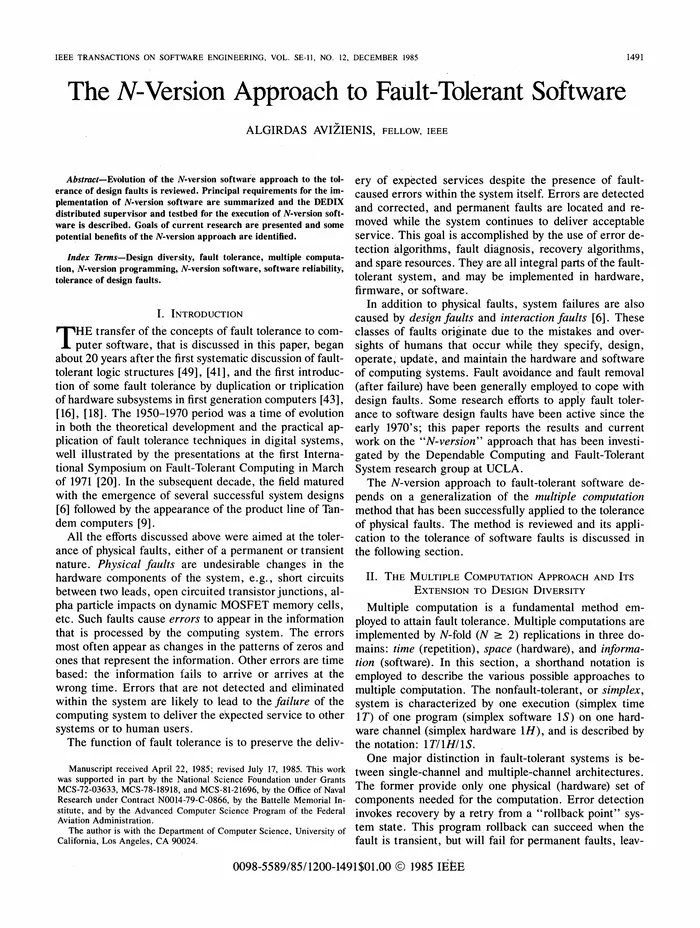
Applied to AI-generated blockchain clients, the appeal splits into at least two distinct modes.
Pool-level sampling. A validator set where each operator independently picks which AI-generated implementation to run is really just client diversity at the network's existing scale, made cheaper: each validator is effectively sampling from the space of possible client implementations, the same mechanism the Client Diversity section above already covered — AI just compresses the cost of standing up each option in that sample.
Local ensembles. The more literal reading of NVP, and the one usually meant by the "run more versions" pitch: instead of one validator running one client, a single operator runs a local ensemble of two or three lightweight AI-generated clients in parallel and only broadcasts a state root once a majority of the internal versions agree — catching a bug locally, before it reaches the network, rather than relying on the whole validator set to catch it after the fact.
The problem is that NVP's founding empirical result already complicated the "just run more versions" story, decades before LLMs existed.
Knight and Leveson's 1986 study — the field's canonical independence test — had 27 programming teams independently implement the same specification. They found that versions failed on the same inputs far more often than chance would predict, against the independence assumption NVP's fault-masking guarantee depends on.
That result has stood for four decades as the reason NVP is a real technique with a real asterisk, not a free lunch: independently-written doesn't reliably mean independently-failing.
"The results of the tests revealed that the programs were individually extremely reliable but that the number of tests in which more than one program failed was substantially more than expected."
Knight and Leveson's result was about human teams. LLM-generated clients have a more specific version of the same problem: models trained on overlapping public code — the same GitHub repositories, the same Stack Overflow threads, the same Ethereum and Rootstock documentation — share statistical priors and reach for the same shortcuts. When a protocol specification is ambiguous, independently-prompted models don't just occasionally converge on the same bug — they're drawing from the same well, a structural reason to expect correlated failure, not an incidental one.
That's not speculation extrapolated from forty-year-old data about human teams — it's already been tested directly against AI-generated code.
Ron (2026) re-ran the Knight–Leveson experiment with modern coding agents: 48 agent-generated implementations of a complex specification, tested against a million inputs.
Common-mode failures showed up clearly, as expected — but three-version majority-voting ensembles still cut the average failure count from 387.44 down to 130.99, a real, roughly two-thirds reduction, not the near-elimination full independence would potentially deliver.
Nogueira et al. (2026) quantified the gap more precisely: across 224 coding problems, twelve LLMs, five languages, and three prompting strategies, ensembles captured only 0.43–0.44 of the reliability gain a theoretically independent ensemble would deliver — a ratio that drops below 0.3 when the ensemble is the same model prompted multiple times rather than structurally different models.
The one piece of good news in that number: heterogeneous ensembles — different base models, not the same model sampled repeatedly — do meaningfully better than same-model ones. If AI-driven client diversity is going to work at all, which models write which client isn't a cosmetic choice — it's the whole ballgame.
05 Open Problems
Five open problems come out of this cleanly, and they're legitimately open rather than solved-but-uncredited — two about a more ambitious architecture nobody's built yet, three about what's still unmeasured or unpaid for in what already exists.
Automated Specification Extraction
Most reference-as-spec chains, Rootstock included, have no machine-provable formal specification to generate variants against in the first place — an agent extracting one from rskj's Java source risks inheriting the exact quirks and bugs the extraction was supposed to leave behind. This is where Monperrus's finding, covered in Related Work below, earns its keep: if the specification, not any one implementation, is the artifact of record, "N versions" stops meaning "N codebases to maintain forever" and starts meaning "N regenerable outputs of one maintained spec" — which quietly weakens the resource-overhead argument from Why Nobody Builds a Second Client.
This blog's own look at agentic underspecification is the concrete precedent for what that extraction risk actually looks like: CCC, a multi-agent loop's from-spec C compiler, passed all 8,421 GCC torture-test cases and 91% of the LLVM regression battery — then produced 19 silent miscompilations in just 202 runs the moment an independent fuzzer used inputs the build loop hadn't anticipated. An agent-extracted rskj spec that passes every test it's checked against could be hollow in exactly the same way, and wouldn't know it until something outside its own test suite went looking.
That framing needs its own caveat, though, held up against this post's own N-Version Programming argument: a single shared spec generating every implementation is a potentially tighter common-mode-failure coupling than today's separately-trained AI-generated codebases, not a looser one. Different LLMs trained on overlapping public code still each read that code slightly differently; N clients generated from one literal machine-checked specification inherit exactly the same gaps in that specification, with no independent reading of anything to catch what the spec itself got wrong.
Does a shared spec trade correlated implementation bugs for correlated specification bugs? These are arguably easier to audit, one artifact instead of N, but aren't automatically safer, and nobody has tested whether it actually is.
The Client Scope Spectrum, Generated
The source's own four open problems don't name it directly, but the four case studies above aren't actually building the same kind of thing. Rustock and ETH2030 are full execution clients maintaining complete state; Guillotine is narrower — an isolated EVM execution engine meant to plug into different node shells; SHiNode is narrower still — a light-client-style indexer that only validates headers and serves logs, never touching full state. Treating "client diversity" as one target obscures that these sit on a spectrum — full node, light client, indexer — each trading completeness for resource cost, and each currently built as a separate, unrelated agent project rather than tiered outputs of anything shared.
If Monperrus's framing (below) is right and the specification becomes the artifact of record rather than any one implementation, that spectrum stops being three things to babysit independently. A full-state executor, a header-and-log-only indexer, and a stateless light client could in principle be three generated projections of one machine-checked spec, provably consistent with each other because they trace to the same source rather than three independent guesses at what a Java reference client does.
Nobody in the four case studies above is doing that yet — but it's the more ambitious version of the specification-extraction problem, and arguably the more valuable one: not proving one client correct, but generating a whole consistent family of them from a single source of truth.
Quantifying Failure Independence
Nogueira et al.'s methodology, covered in Related Work below, is a real answer to "how would you even measure this," and it's more textured than a single independence ratio. They measure three things separately — structural diversity (how differently two implementations are written, via pairwise CodeBLEU similarity), behavioral diversity (whether two implementations fail the same test inputs more often than a hypergeometric independence baseline predicts), and N-version reliability (what majority voting over three or five implementations actually buys you) — then add a manual fault-analysis pass, because two implementations can fail identical tests for different underlying reasons, or fail different tests for the identical underlying bug; pass/fail overlap alone can't tell those apart.
The headline number from applying all of that to 224 competitive-programming problems, twelve LLMs, five languages, and three prompting strategies: majority voting over five independently-generated implementations raises average reliability from 0.88 to 0.91 — a real improvement, but less than half of what a genuinely independent five-version ensemble would have delivered, and the paper found that gain depends far more on which models get mixed (heterogeneous beats same-model) than on which language or prompting strategy is used.
The manual fault analysis underneath that number is the more unsettling finding: implementations that looked structurally distinct kept failing for the same root cause, exactly the failure mode majority voting exists to catch and, here, mostly couldn't.
However, a methodology isn't a deployed metric — nobody is running anything like it against live validator sets today, so there's no equivalent number for Rustock, ETH2030, XVI/Guillotine, or SHiNode, only for the twelve models Nogueira et al. tested in isolation.
Full-Node Formal Proof Generation
This blog's own two-part look at verified consensus covers the closest existing precedent: Lean 4, Rust-to-Lean transpilation via Aeneas and Charon, and AI-orchestrated proof search have real, machine-checked traction on consensus algorithms specifically — five named protocol case studies, genuine zero-sorry proofs — but, as Part 2 found, not one of them closes the loop end-to-end, from a hand-written formal spec straight through to the actual production binary.
The same toolchain is, in principle, available for a full execution client too, not just its consensus layer — the open question isn't whether the tools exist, but how much of an EVM engine, state trie, and P2P stack that machinery can actually reach before the person-years catch up with it.
In-Protocol Diversity Incentives
Nothing today pays a validator more for running a minority or AI-generated client; the client-monopoly trap from Why Nobody Builds a Second Client is an economic problem, and cryptographic proof-of-diverse-execution schemes remain a research direction, not shipped infrastructure — the closest thing to a working prototype is Ron et al. (2025), from the same Ron and Monperrus already cited above: a zkVM- or TEE-generated proof of which client a validator is actually running, checked on-chain, feeding a reward that pays out specifically to minority-client operators.
They modified Ethereum's Lighthouse client to demonstrate the mechanism end-to-end and measured the proof overhead — a real answer to "how would you even pay for this," but a modified fork of one consensus client under lab conditions, not a reward scheme live on any production network.
Deploying these schemes across thousands of validators in the wild remains as future work.
06 Related Work
Ron (2026), "N-Version Programming with Coding Agents," and Nogueira et al. (2026), "A Systematic Methodology for Evaluating Failure Independence in LLM-Generated Code," are the category's two really load-bearing papers — the actual empirical case behind this post's central claim, covered in full, with numbers, above. The one thing the source's own framing leans away from is just how sobering Nogueira et al.'s independence ratio actually is.
Ron et al. (2025)'s Galápagos is the most directly relevant prior system named in Related Work: it couples multi-language LLM code generation with formal equivalence checkers, aiming to protect against compiler miscompilation faults by construction rather than by hoping for independence after the fact — closer to what full client-diversity tooling would eventually need.
Monperrus (2026), "Bootstrapping Coding Agents: The Specification Is the Program," checks out cleanly too: a coding agent bootstraps itself from a natural-language specification, and the paper's finding is that the specification — not the generated code — becomes the stable artifact of record, regenerated and reverified on demand rather than hand-maintained forever. It's the odd one out among the four, less about measuring independence and more about what these clients would need to stay maintainable long-term — which is exactly the open problem it got put to work on, above.
Larsen et al. (2014), "SoK: Automated Software Diversity," systematized more than two decades of prior work on generating multiple variants of the same program — but for a different purpose than any of the four papers above.
Their diversity is a security mechanism (randomizing a binary's internals so a single exploit can't be replayed across every copy of it), not a fault-tolerance one (masking an implementation bug by majority vote). Two research communities have used the word "diversity" for two decades without much cross-talk between them; a client-diversity effort aimed at AI-generated blockchain nodes sits closer to the fault-tolerance tradition, but the security-diversification literature is exactly where the "common-mode failure" problem above has already been studied under a different name — correlated weaknesses across supposedly-independent variants, just with an attacker instead of a bug picking the input.
A second adjacent tradition, also worth naming honestly rather than stretching to fit: Lefeuvre et al. (2024)'s "SoK: Software Compartmentalization" systematizes 211 research efforts on the opposite direction from generation — taking one already-written system and splitting it into privilege-limited components after the fact, for containment rather than diversity. It doesn't touch AI generation or blockchain clients at all.
What it does share with the full-node/light-client/indexer split discussed above is the underlying shape of the problem: components that have to interoperate through a well-defined boundary while staying independently reasoned-about. A generated family of clients would need exactly that boundary discipline — compartmentalization's two decades of hard-won lessons on where such boundaries tend to leak are a reasonable place to start looking, even though nobody has yet connected that literature to component generation the way this open problem would need.
07 Conclusions
Building a second blockchain client implementation used to require years and a dedicated team, and AI coding agents have genuinely collapsed that to weeks and a handful of engineers. Rustock, ETH2030, XVI/Guillotine, and SHiNode are real projects that really did that — checked against their own repositories.
What doesn't hold up as cleanly is the implicit conclusion that cheaper client-writing equals more client diversity in the sense that actually matters. N-Version Programming's fault-masking guarantee has needed an asterisk since Knight and Leveson's 1986 study, decades before an LLM ever wrote a line of Rust — and the best current evidence on AI-generated ensembles specifically, Ron's and Nogueira et al.'s 2026 results, says real fault reduction is achievable, full independence isn't, and same-model ensembles are the weakest version of the idea, not the strongest.
Rustock's own README says the quiet part out loud: a fast, working client is a genuine milestone, and "safe to run in production, alongside rskj, as a real second vote in the network's consensus" is a different one — not yet reached by any of the four.
None of that is an argument against trying. It's an argument for reading the case studies the way their own authors did: Javier Cid's own post warns the code he wrote "could fork the network without warning." Vitalik Buterin called ETH2030 an impressive experiment, not a production client, in the same sentence where he said so.
Client diversity generated by AI agents is a real and promising direction — the honest version of that claim includes the caveats the sources themselves already wrote down.
References
- Cid, J. (2026). "A blockchain node written entirely by AI. Can we trust it?" Medium. Available at: medium.com
- rustock — AI-assisted Rust implementation of a Rootstock (RSK) full node. Available at: github.com/javicid/rustock
- ETH2030 — experimental Go execution client implementing Ethereum's long-range protocol roadmap. Available at: github.com/jiayaoqijia/eth2030 · eth2030.com · Development Stats · Gap Analysis
- Buterin, V. (2026). Public reaction to ETH2030. Available at: x.com/VitalikButerin
- Drake, J. / Ethereum Foundation Architecture Team (2026). "L1 Strawman." Available at: strawmap.org
- XVI — Zig execution client under the evmts initiative. Available at: github.com/evmts/xvi
- Smithers — React/JSX multi-agent workflow orchestrator used to build XVI. Available at: github.com/evmts/smithers
- Guillotine — EVM execution engine backing the Tevm project; human-led with disclosed AI-assisted contributions, Ethereum Foundation-funded. Available at: github.com/evmts/guillotine · guillotine-mini
- SHiNode — lightweight Ethereum history indexer by vicnaum. Available at: shinode.rs · github.com/vicnaum/shinode
- Avižienis, A. (1985). "The N-Version Approach to Fault-Tolerant Software." IEEE Transactions on Software Engineering, SE-11(12), 1491–1501. Available at: doi.org
- Knight, J. C., & Leveson, N. G. (1986). "An Experimental Evaluation of the Assumption of Independence in Multiversion Programming." IEEE Transactions on Software Engineering, SE-12(1), 96–109.
- Ron, J. (2026). "N-Version Programming with Coding Agents." Available at: arXiv:2606.20158
- Nogueira, R. P., et al. (2026). "A Systematic Methodology for Evaluating Failure Independence in LLM-Generated Code." Available at: arXiv:2607.02808
- Ron, J., Cabrera-Arteaga, J., Monperrus, M., & Baudry, B. (2025). "Galápagos: Automated N-Version Programming with LLMs." ACM Transactions on Software Engineering and Methodology (TOSEM). Available at: arXiv:2408.09536
- Monperrus, M. (2026). "Bootstrapping Coding Agents: The Specification Is the Program." IEEE Software (forthcoming). Available at: arXiv:2603.17399
- Larsen, P., Homescu, A., Brunthaler, S., & Franz, M. (2014). "SoK: Automated Software Diversity." IEEE Symposium on Security and Privacy (S&P). Available at: oaklandsok.github.io
- Buterin, V. (2017). "The Meaning of Decentralization." Available at: medium.com
- Ethereum Foundation. "Client Diversity." Available at: ethereum.org
- CoinDesk (2024). "Bug on Ethereum's Nethermind Software Sparks Discussion of Client Diversity Risks." Available at: coindesk.com
- BlockEden.xyz (2026). "Solana's Client Diversity Moment: Firedancer, Agave, and the Race to One Million TPS." Available at: blockeden.xyz
- Client Diversity Dashboards: clientdiversity.org (Ethereum consensus layer) · execution-diversity.info (execution layer)
- Ron, J., He, Z., & Monperrus, M. (2025). "Proving and Rewarding Client Diversity to Strengthen Resilience of Blockchain Networks." ACM Distributed Ledger Technologies: Research and Practice. Available at: arXiv:2411.18401
- "Value Overflow Incident" (CVE-2010-5139). Available at: en.bitcoin.it
- Andresen, G. (2013). BIP 50: "March 2013 Chain Fork Post-Mortem." Available at: github.com/bitcoin/bips
- Lefeuvre, H., Dautenhahn, N., Chisnall, D., & Olivier, P. (2024). "SoK: Software Compartmentalization." Available at: arXiv:2410.08434